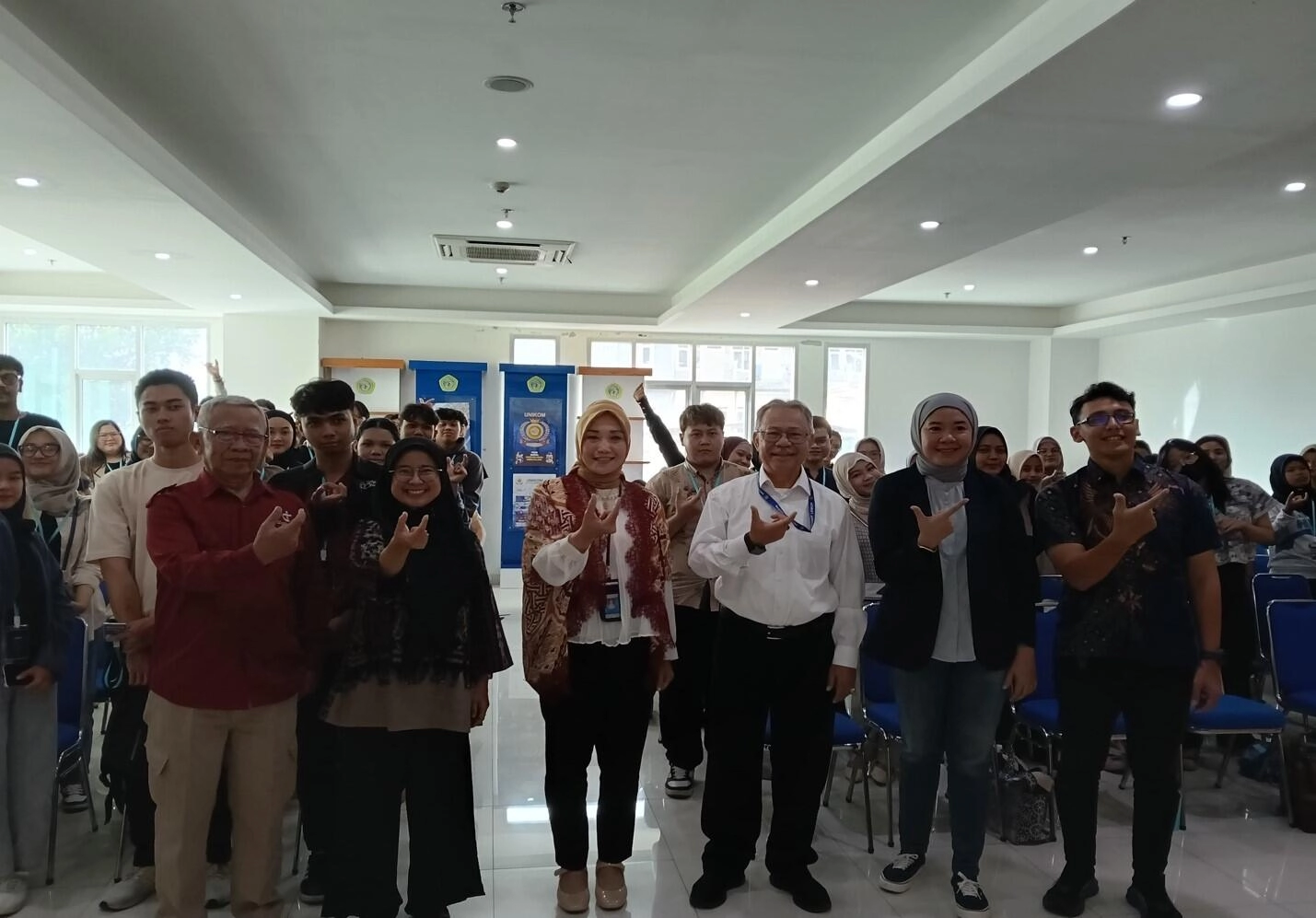
BANDUNG, UNIKOM – Universitas Komputer Indonesia (UNIKOM) again presented an international academic event by holding a seminar entitled “AI, Equity, and Opportunity: Bridging the Digital Divide.” This seminar was held openly for participants from various backgrounds, both offline at the Smart Building on the 17th floor of UNIKOM and online via the Zoom platform. This seminar was the result of UNIKOM’s collaboration with APTISI West Java, Binus University, and the International Institute of Applied Informatics (IIAI).
The event presented a number of renowned speakers in the field of artificial intelligence and applied informatics, including: 1) Prof. Tokuro Matsuo, Ph.D – CEO of IIAI and Professor at Advanced Institute of Industrial Technology, Tokyo, Japan. 2) Prof. Dr. Eng. Takayuki Ito – Kyoto University, Japan. 3) Prof. Zainal A. Hasibuan, Ph.D – UNIKOM Vice Rector IV for Digital Technology & ICT, International Programs & Center of Excellence. 4) Prof. Yuya Yokoyama, Ph.D – Advanced Institute of Industrial Technology, Japan. 5). Prof. Dr. Ir. Ford Lumban Gaol, SMIEEE – Head of Computer Science Doctoral Department, Binus University. The event was hosted by moderator Dr. Salmon Priaji Martana, S.T., M.T., as UNIKOM’s Deputy Director of International Affairs & Cooperation.
On this occasion, the Rector of UNIKOM and the Chairperson of APTISI West Java, Prof. Dr. Ir. H. Eddy Soeryanto Soegoto, M.T., thanked IIAI, BINUS University, and APTISI for working together in organizing this event. Prof. Eddy also emphasized that “the workshop ‘AI, Equity, and Opportunity-Bridging the Digital Divide’ and artificial intelligence are no longer a distant future; they already here, changing the way we do research, innovate, and expand knowledge. This event is more than just a discussion about AI capabilities. Through this workshop, we aim to bridge the digital divide by equipping researchers, educators, and students with the skills to utilize AI in their academic activities.” Prof. Eddy said.
Prof. Dr. Eng. Takayuki Ito from Kyoto University, Japan, discussed online material on how the use of Artificial Intelligence (AI) is implemented into everyday life. He was also invited to discuss the future of Indonesia. Meanwhile, Prof. Tokuro Matsuo, Ph.D., as CEO of IIAI from Tokyo, Japan, said that “AI systems will continue to learn and learn to provide smarter answers in the future. So, there must be a balance. Sometimes we use LLM and AI, but other times we learn in class; we still have to learn using textbooks and the internet, and sometimes we use LLM and AI to find more information,” said Prof. Tokuro.
Prof. Yuya Yokoyama, Ph.D., of the Advanced Institute of Industrial Technology, Japan, argued that “AI is very useful for life, but at the same time, we must look at the weaknesses; that is, AI can produce something, but we should not trust the results, for example, fake news or fake pictures. There are real figures of people, but their faces are different from other people, and we must assess whether the results are correct or not. Maybe sometimes, but we have to evaluate the content,” said Prof. Yuya.
The last presentation of material on AI, delivered by Prof. Dr. Ir. Ford Lumban Gaol, the Head of the Doctoral Computer Science Study Program, BINUS University, explained the purpose of AI from his perspective: “AI itself is indeed one of the targets for development for millennial generation friends, especially students; the second is in the context of digital literacy. AI is the key word because there are so many applications or various learning aids that are AI-based; maybe we know the ChatGPT model, which has recently been massively used by students. Today, we bring a bigger context called hyperdemocracy, where people or society can see AI itself in the context of moderating and also taking a consensus from discussions that exist online. Because whatever happens in the world of democracy, everyone has the right, has the desire, and has the freedom to speak,” he concluded.
This discussion was followed by a question and answer session with the participants guided by the moderator. It is expected that this workshop can become a forum for academics, students, and professionals in understanding the challenges and opportunities in the growing digital era.