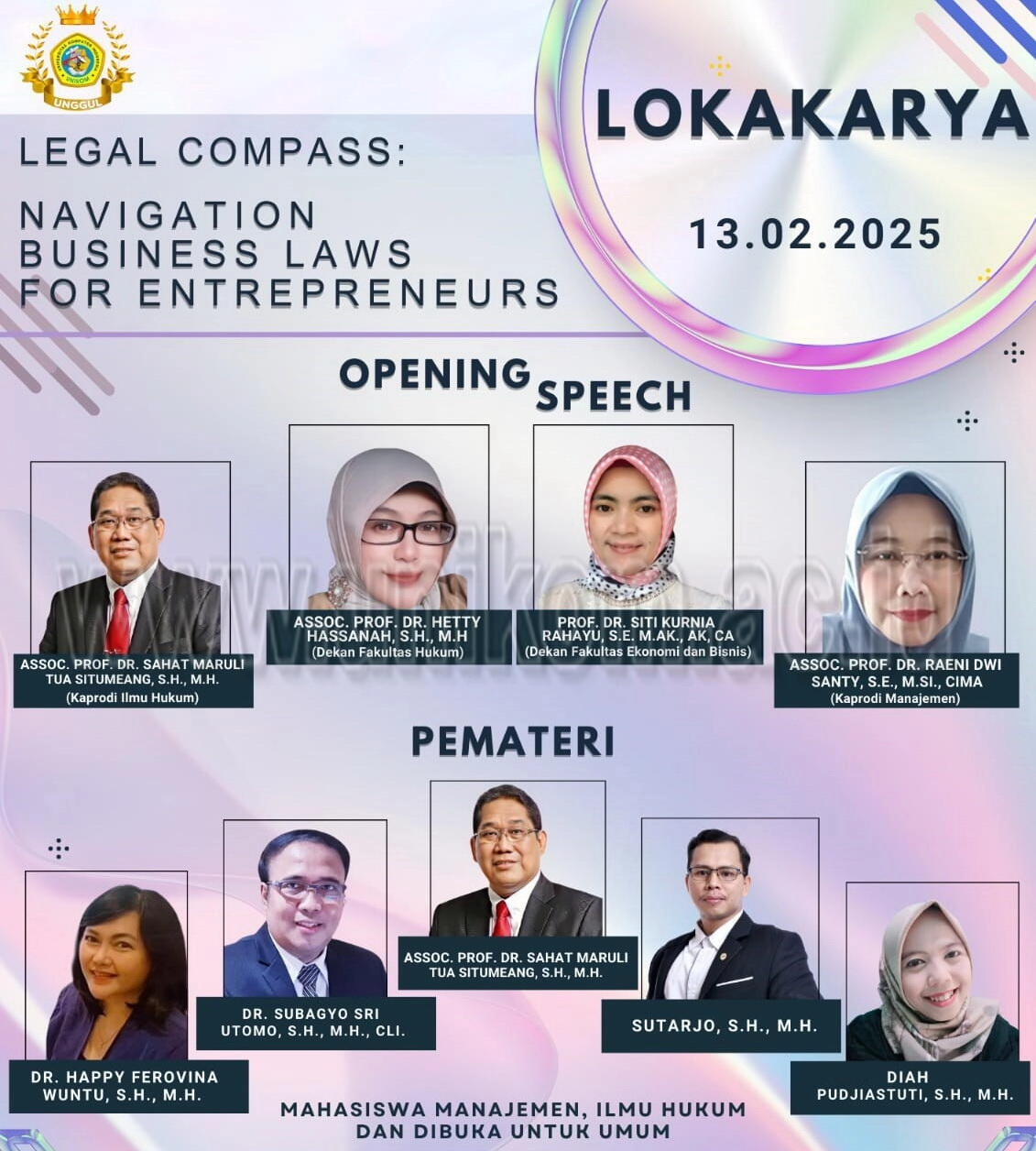
BANDUNG, UNIKOM – The Management and Law Study Programs of Universitas Komputer Indonesia (UNIKOM) held a workshop entitled “Legal Compass: Navigation Business Laws for Entrepreneurs” on Thursday, February 13, 2025. The event was held online via the Zoom platform from 08.30 to 13.00 WIB and was attended by 114 students from both the Management and Law Study Programs, as well as other general participants.
The event was opened with remarks from the Head of the Management Study Program, Assoc. Prof. Dr. Raeni Dwi Santy, S.E., M.Si., CIMA, who represented the Dean of the Faculty of Economics and Business, and the Head of the Law Study Program, Assoc. Prof. Dr. Sahat Maruli Tua Situmeang, S.H., M.H. In their remarks, they emphasized the importance of understanding business law for entrepreneurs, especially in facing regulatory challenges in the globalization era. The collaboration between the two study programs is a manifestation of cross-disciplinary synergy to support the sustainable development of the business world.
This workshop presented five expert speakers who discussed crucial issues in business law. One of the highlighted topics was corporate crime. Assoc. Prof. Dr. Sahat Maruli Tua Situmeang, S.H., M.H., explained that monopolistic practices, money laundering, tax evasion, and labor exploitation are challenges in the business world. Although there are regulations, the implementation is still weak due to the difficulty of proof. He highlighted the need for strict supervision and strict penalties to prevent these illegal practices from harming many parties.
Meanwhile, Dr. Happy Ferovina Wuntu, S.H., M.H., discussed the importance of understanding business contracts. She stated that a contract is not just a formality, but a tool to protect the rights of the parties. Before signing a contract, it is important to ensure the identity of the parties, check the contents of the contract, including their respective rights and obligations, and pay attention to the force majeure clause. She also suggested to not hesitate to consult with legal experts if there is any ambiguity.
Employment issues were also highlighted. Dr. Subagyo Sri Utomo, S.H., M.H., CLI, explained that the welfare of workers in Indonesia is still a major concern, especially for informal sector workers who have not received adequate legal protection. Efforts that can be made include stricter enforcement of regulations against companies, counseling on workers’ rights, and strengthening trade unions as a forum for labor advocacy.
Sutarjo, S.H., M.H., discussed the challenges faced by Small and Medium Enterprises (SMEs) in facing business competition. Monopolistic and cartel practices are a threat to SMEs. To support SMEs, access to capital, regulations that protect small businesses, and public awareness in choosing local products are needed. If business competition is healthier, not only SMEs benefit, but also consumers who can get more choices at fairer prices.
Diah Pudjiastuti, S.H., M.H., explained the difference between bankruptcy and insolvency and the role of curators in managing the assets of insolvent debtors. She highlighted that curators often face obstacles, such as lack of cooperation from debtors, difficulties in recording and securing assets, and the risk of criminalization against curators who carry out their duties. Therefore, a more transparent and accountable system is needed in handling bankruptcy.
This workshop provided a comprehensive insight into the importance of understanding business law for entrepreneurs. The participants are expected to implement the knowledge gained to run a business legally and ethically. The collaboration between the Management Study Program and the Law Study Program shows UNIKOM’s commitment in supporting the development of a sustainable business world through cross-disciplinary synergy. The event was closed with an interactive question and answer session, where participants actively asked questions and shared responses. This workshop is expected to become a regular agenda to improve legal literacy among students and the wider community.
